Showing posts with label forest garden. Show all posts

Monday, 24 February 2020

Meadow Mania

I've become increasingly intrigued by the idea of growing a sown understorey to my forest garden, rather than the Plan A system of first planting trees and shrubs within an area of rough grass and then gradually opening up bed areas in which to plant useful herbaceous plants.

Bed areas are so expensive, not to mention high maintenance! I have several species of creeping weed that keep creeping in and smothering my herbs, which drives me nuts, makes a right mess of my lovely beds and gives me loads of work each year sorting it all out.

So Plan B - have just a few of the lovely herbaceous beds in gaps around my trees and shrubs, but otherwise sow a wildlife meadow. This will look great, will be really wildlife friendly and will need a fraction of the work to maintain.

With this in mind, I've found a local supplier of meadow seed and have been digging in to James Hitchmough's inspirational book 'Sowing Beauty' for tips on how to successfully grow beautiful perennial groundcover communities straight from seed. If you can get hold of a copy, I definitely recommend this book.


I'll be sowing meadow plants, as my ground is quite open and sunny, but in future when my trees have grown some more, I'm really keen to try using his techniques to grow a more low growing woodland understorey and also to try incorporating a mixture of both wildlife friendly and edible plants. Using seed rather than plants will save loads of money and by covering the ground in a year, it will take less work in the end to get a really full ground cover layer to the forest garden. The book has loads of tips on how to select appropriate plants for any given situation - right plant, right place being the key to success with this system.

For now though, with my plant choices pre selected by my local meadow seed supplier, here are my favourite top tips for getting a seed mix established:

1. Make sure you irrigate well from early spring to early summer. By this he means once every couple of days, which sounds like a lot to me, but he suggests this can have a huge impact on seedling emergence and survival. Evening irrigation is of course much more beneficial than morning irrigation.

2. Manage slugs. A top tip here if we're avoiding slugicide is to sow into a sand mulch. The most at risk areas are those near long grass or hedges - generally the boundaries of the site to be sown. Also risky are north or east facing slopes and clay soil covered in a compost mulch (being a very moisture retentive situation).

3. Weed control. You need to make sure your chosen species are dominating any weeds by the end of the first growing season (i.e. by autumn). This will mean you get a nice closed canopy of your chosen plants, which will keep future weeds at bay in future years. Sowing into a mulch can help with getting your plants established in a reduced weed environment and then spot weeding during the first year to reduce weed dominance may also be needed. The best time for taking out weed seedlings is generally early summer, when weeds are easy to identify. He suggests hand weeding on all fours, using string lines to mark up weeding aisles of about a 1.2m width, to make it easier to be systematic about covering the whole area.

Where time is limited, take out the most problematic weeds only - these are perennial clump forming plants, such as docks and creeping plants, such as bindweed, creeping thistle, couch grass and nettles. Creeping buttercup and clover can be a bit of an issue, but being shorter, are less problematic in meadow or prairie sowings. The best time for taking out perennial weeds is over winter and early spring when the plant cover is more open and accessible.


Monday, 10 December 2018

Winter Salad from the Foraging Garden

This week, I'm joining in with the lovely Happy Acres Blog's 'Harvest Monday' feature and am sharing my morning's harvest with you. It's the beginning of my abundant free salad season - my perennial salad plants seem to be at their best from now through until the spring, so I'm looking forward to a season ahead with lots of fresh salad. I'm also feeling super chuffed at not having had to lift a finger to make that happen!

So for my lunch time salad today, I picked:

Some wild rocket from the flower bed. This plant is probably about five years old now and I thought it had had it actually. But as you can see, it's still soldiering on, even if it is a little long in the tooth!

It's just starting to pick up after I chopped all the flower heads off during the autumn, so this is the start of my rocket season. During the summer, I still use it a little, but it tends to get little holes nibbled into it from flea beetles, so I'm a bit selective about which visitors I feed it too! Over winter this isn't a problem. Today, I used this as the bulk ingredient.


Nearby, I still have a little milky bellflower in leaf, which is good and mild flavoured again now it's finished flowering.


I also picked a little sweet violet leaf from under my apple tree. This one tastes good, but is a little hairy. Not the texture you tend to think of when planning a salad! So I just put a little in and generally no-one notices.


My lamb's lettuce is just starting to come through. I bought seed for this maybe ten years ago now and since then I've never needed to sow it again - it appears in my vegetable beds (and some flower beds) each autumn and grows away until it flowers and goes to seed in the spring. At that point, I weed it all out to make room for vegetables, but so long as I let it seed, it always comes back in the autumn. This is a really good, mild salad leaf with lovely flavour and texture. A little later in the winter I should be able to use this as a bulk ingredient too. Right now I just have little bits to use, but it's well worth adding in nevertheless.


Also in the vegetable garden are a  few marigold plants, which are still flowering away well. I just use the petals, although you can eat the whole flower.


Over to the forest garden, I have some new salad plants - my saltbushes. These are related to quinoa and so are really mineral rich. And they really do taste salty! The leaves have a great texture and the flavour is really good too.


Lastly were some primrose flowers from under my silver birch tree.


We ate this for lunch with a simple honey, oil and vinegar dressing and some roast squash.


For more harvesting inspiration, head over to Happy Acres to see what else is coming out of the garden right now!

Monday, 27 April 2015

The Forest Garden Begins

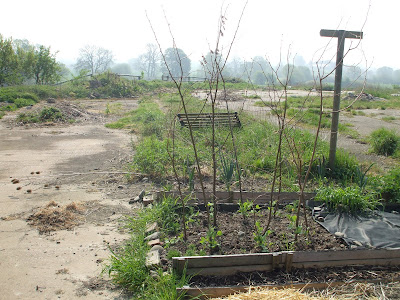
At last, I feel I can say that we have a proper forest garden - albeit a very young one - and not just the little foresty bits around the edges that it's been for so long. We've been planning and working towards this for years, having started with an old yard covered in concrete. This winter, with soil preparations suitably advanced over part of the plot, it was finally time to get planting.

And now it's Spring, I'm enjoying watching them all wake up for their first year at Oak House.

So let me introduce you:

Walking along towards the forest garden from the house, we first come across the Medlar, welcoming us through onto the main pathway. This one is for David and I've promised to give it a try, but have to admit it sounds revolting - you apparently leave the fruit on the tree until they've putrified inside and then suck out the gooey middle. It apparently tastes a bit like caremel and David swears it's heavenly. I'll keep you posted!

The borders to the main path are yet to be planted, so we'll head along a little side path up onto the bank.


This is where the chop and drop soil improving plants have had a couple of years getting the soil ready for me and so this is where I've been busy planting out this winter. In the photo above you can see cocksfoot grass and red clover, both of which are fast growing and deep rooting, so help both break up my compacted soil and add lots of humus if I chop them back regularly. All the plants going in here are shade tolerant as this is the northern edge of the forest garden.

Next along this side path, we come across the Califonia Allspice - a suckering shrub whose bark can be used as a cinammon substitute. I can't wait to give this one a try!


This plant is normally dark red flowering, but I'm aiming for a more naturalistic woodland look, so went for a less exotic, green-white flowering variety called California Allspice 'Athens'. The flower buds are just forming now, as you can see above.

Along the path, I've planted several red currants - this is one of the best fruit bushes for shady areas, so planting it along the northern edge of my plot seemed a sensible idea.


In the background of the photo above, you can see one of my many broom plants. I have them scattered around, their main purpose being to fix nitrogen to feed all my growing plants. I also use them as a chop and drop mulch to improve the soil. Being a woody chop and drop, it's even better for helping to create a woodland type soil, feeding the kind of soil organisms you'd expect beneath trees.

Next to the redcurrant pictured above, I've planted a little aquelegia as an early perennial salad crop - the leaves are very good in a mixed salad in the early part of the year as the young ones are just emerging. It's also good for pollinating insects once it starts flowering in late spring. It's good here, as it tolerates part shade.


A little further along is an apple tree - Tom Putt - a good all rounder.


Travelling around the corner, past more red currant, we come to the lovely Lizzie Plum. Another one I can't wait for. I have to admit to being totally sold on the catalogue photo of the fruits of this one - big, juicy, dark red plums. Makes my mouth water just thinking about it! No flowers yet though, so I'll be waiting a while to try them.


This is underplanted with lupins for nitrogen fixing and pollinating insects.


Nearby is one of my honey berry bushes - these are a non climbing relation of honeysuckle, that produce blue fruits which apparently taste a little like blueberries, but with a honey aftertaste.


Last along the path is the Mulberry. I just had to have one of these as they are my all time favourite fruit. Like giant raspberries, but with way more flavour. Wonderfully juicy, a little tart and extremely more-ish.

Later this year, I hope to get a few more understorey plants in. I've not decided exactly what yet, but am looking forward to selecting a good mix of useful and edible plants. Comfrey, strawberries... Any suggestions are welcome!


Wednesday, 17 December 2014

Plant Led Soil Improvement

We didn't find brilliant soil when we stripped up the concrete. It was pretty heavy clay and pretty well compacted too - especially after being driven over with heavy machinery several times. So in order to fulfill my dreams of a highly productive forest garden, some soil improvement was definitely in order. And me being me, I searched for ways to achieve this using plants.

I found inspiration from two main places. Firstly Martin Crawford's fantastic book 'Creating a Forest Garden', where he talks about dealing with compacted soil by growing deep rooting ground covers. Equipped with the useful information he gave, I hunted down seed mixes on the internet and discovered Cotswold Seeds' Humus Builder. This includes deep rooting and fast growing plants - Cocksfoot grass, red clover and chicory - which can be cut down several times a year in order to add humus to the soil, while their roots work down and through the soil, improving structure. So this got added in the spring of 2013 and has been growing well ever since alongside several species of self seeded plant.

And then I read what has become a very influential book - Teaming With Microbes, by Jeff Lowenfels and Wayne Lewis. This book describes soil food webs in detail and explains how not only are they crucial in providing plants with the nutrients they need, but also how they differ for different types of plant. And then the book describes how you can enhance your own soil food webs or - more relevantly to me - nudge them in the direction they need to be for the types of plant you want to grow. Basically forest soils have different combinations of microorganisms in them to flower beds and it's these specific combinations of microorganisms that provide an appropriately balanced diet for plants in natural perennial systems. Nurture a healthy and appropriate soil food web and your plants will thrive. So if I want to grow a forest garden, my soil doesn't only need more humus and better drainage, it needs a decent set of microorganisms and this means I get to use a favourite technique - Permaculture Principle 10 - use and value diversity.

The way to do this is to think logically - in a forest, the soil food web is fed by falling leaves and branches - this encourages fungi to dominate at the smallest of levels and fungi are great at providing the right kind of food for trees and shrubs. In flower beds, lawns or vegetable gardens, it's a different picture - you get more green materials falling - it's the bacteria that love this and so thrive here, providing nitrogen in a different format to fungi, and one that is appropriate for the less woody plants.

So with this in mind, I need to start dropping more brown and woody materials onto my forest garden area, not just the green humus building plants from my soil improving seed mix.

At the moment, I have two strategies for this -

1. I've planted lots of broom plants - they grow fairly quickly and can be trimmed to provide woody materials to leave lying around on the ground. They also, of course, provide nitrogen, which my trees and shrubs and any other plants going in here will need to grow quickly. So double hit from the broom - just the kind of plant I like.

2. I've also put to use as a mulch the huge mountain of trimmings I got from pruning ivy and virginia creeper from a barn roof this autumn. I've laid it in the specific areas where I intend to plant trees and shrubs. Hopefully they'll act as little nurseries for all the kinds of soil organisms I need in a forest system, helping to nudge things in the direction I need in advance of getting those trees and shrubs planted out this winter.

I would love to record the impact of this and put to use some of the environmental monitoring techniques I learned while at uni. Wouldn't it be great to map how the soil food web changes over time. If I find the time to do this, I will of course keep you updated.

Saturday, 6 August 2011

Cover Crop Legumes

When you're making a forest garden (or any productive garden for that matter), the success of the system is heavily dependent on how well you maintain soil fertility.

You've got to make up for the fact that you're going to be continually harvesting food (= soil-derived nutrients) from the land. In our case, working on a pretty impoverished piece of land, we're making this a very high priority. So I'm busy getting to know my legumes.

I've written about these a few times before, focusing mainly on white clover. Legumes are great for the soil as they team up with friendly bacteria to fix nitrogen from the atmosphere into the soil. Used as a chop and drop mulch, they're really good at building up organic matter and fertility for your soil.

My next trial will be of five species of legume commonly used as green manures for organic vegetable growing. These are all short-lived plants (mostly one season only), so can easily be replaced when I'm ready for it, by the cosmetic herbs or perennial vegetables that I've ultimately got planned to make up my forest garden understorey.

Over the next year, I'll be trying out crimson clover, agricultural lupins, trefoil, field beans and winter tares. I'll be testing them out in a couple of spots that I've had under a cardboard mulch this year.

Crimson clover is one that that grows through the summer - it can be sown from April until September and then you cut it back in autumn. It's vigorous and fast growing, so I've been sowing this one out this week and am hoping for some growth before I cut it back in the autumn.

The lupins are another one to sow in spring and cut back in autumn. They're deep rooting, so good for breaking and aerating the soil. We'll need a lot of that for any compacted soil we find under that concrete. I imagine these will be quite tall, so I'll need to be careful not to sow them too close to any of the fruit trees, fruit bushes and cosmetic herbs that I've got growing through my cardboard mulch.

Winter tares will last through the cold of the winter, but can be sown from as early as March, right up until September, making them look like they can be used either for summer and/or winter. These are basically a vetch and we've already got lots of that growing locally and on site, so it should do well.

Trefoil will also last through the winter, and will make fairly short plants, so they are going to be good options for sowing in amongst my existing plants and trees. This one gets sown anytime between March and August. Like the tares, we've already got birds foot and lesser trefoil growing on site, so it clearly likes our climate and soil type.

Lastly, field beans. These also grow through the winter (sow from September) and, like the lupins, are deep rooting so should join them in helping to break up any compacted soil. Again, like the lupins, I think these are going to be tall plants, so I'll need to be careful about where I put them.

Growing green manures is fairly new to me - I've tried it a couple of times, but both times when I was too busy to cut it down at the right time, so it grew too big and was then a pain to deal with. I'm hoping it works better for me this time around. Has anyone else had any experience with this? How did it work for you?

Monday, 23 May 2011

Geoff Lawton on Food Forests

Geoff Lawton has a great way of explaining permaculture principles. I've just found this great little film on youtube and had to share it. Got me thinking up new ideas already for how I manage the growth of my forest garden.


Thursday, 21 April 2011

April Jobs in the Garden

There's a lot going on in the garden this year, so I need to be extra organised to make sure I get it all done!

Here's my garden plan for April:

Vegetable Garden
This month I'll be sowing french beans in the greenhouse - a variety called 'Cherokee Trail of Tears', which has a bit of a back story I'd better let you in on. It was saved by the Cherokee people in North America when they were driven from their lands by the government back in 1838. Their forced march was known as the Trail of Tears and this prolific bean has since been passed on through the generations. I get my seeds from the wonderful Real Seed Company's heritage seed collection.

Also in the greenhouse, I'll be sowing basil and cilantro along with my cucumber and achocha plants. Achocha, if you've not heard of it, is a climbing cucurbit (i.e. related to cucumbers) with small, softly spiked fruits that taste and are prepared just like green peppers - raw in salads or slice and stir fry. But they're much easier to grow in the UK climate. I did a small test run last year of a variety called 'Fat Baby' and they were rather tasty!

Outside I will be sowing kale, purple sprouting and my second batch of lettuce. I will be planting out my first batch of lettuce along with my tomatoes.

I'm rather excited about the tomatoes this year as I've found a very unusual one with tiny pear shaped tomatoes that come on MASSIVE trusses. And from the pictures up on the Real Seed Catalogue pages, I mean MASSIVE!! It's called a cluster pear tomato and I'm hoping to be impressed. I'm also planting beefsteak and just regular medium sized salad tomatoes.

Forest Garden
I'll be planting out my red currants, some raspberries and a witch hazel. Under the red currants/ raspberries I'm going to plant some sweet violet to be used for the edible leaves and flowers.

Under the witch hazel, I'm going to plant out the strawberry plants I potted up from runners last autumn.

Saturday, 9 April 2011

Fruitful Spring

Spring has definitely sprung in the yard. Such a lovely time of year and especially exciting this year as I've been planting more fruit out over winter and giving existing fruit trees a bit of a prune back to help them keep their strength up.

The old damson trees (above) along our boundary are looking great after a good prune over winter. These are making such a beautiful backdrop right now to our first little area of forest garden.

The raspberry canes are also starting to produce little flower buds now. Those in the photo above are our summer raspberries, but we've also got hold of some autumn fruiting plants too. So long as I get round to planting these out, the two different types should give us a good spread of raspberries this year.

Some new fruit bushes that went out on the yard this winter include four lovely gooseberries, of which one is pictured flowering above. Such sweet little flowers when you look up close! We've also planted out three black currants (black currant cordial, mmm) and I have a number of red currants in pots that I'm hoping to get in the ground too.

It's been a good year for potting on strawberry runners. It's so worth the effort of doing this each year to increase your yield - home-grown strawberries picked and eaten while still warm from growing out in the sun really can't be beaten! I've got a few plants in the greenhouse for an early crop of the beauties and the rest are to form a delicious ground cover to go under some of my trees and bushes on the yard.

And finally, our new fruit trees are looking great. Mostly. One of the pear trees is flowering magnificently (photo above). The other is putting out some lovely leaves but doesn't seem quite up to flowers yet bless it - and this is despite being in a more sheltered spot! Perhaps it's got too used to the cozy lazy feel if its corner and is going through the molly coddled teenager phase where it can't quite muster up the energy get on with the serious business of working for its living! The plum, RIP, is looking very sad and I've not had it in me yet to dig it up. Cows. Ba****ds. The apple is looking very happy to be out of its little pot at last and is leafing up merrily.

Hooray for spring! I look forward to a lovely, fruitful year!

Wednesday, 30 March 2011

Reclaiming lost ground

Last year's mulching experiments around the wild edges of our yard were a big success, so I've been reclaiming quite a bit more nettle and bramble covered ground this year using the same techniques. Some areas I'm planting into and other space is going to rest it out under cover until next year.


The most exciting area is a patch I call 'Damson Corner' on account of its numerous damson trees. I've laid on lots of cardboard with inert top soil laid on top of that. Through these layers, I've planted two goosberry bushes, three black currants, plus lots of wildflower plants - my first range of cosmetic/medicinal herb plants. There were already a number of damson trees, an elderflower, a pear and a plum tree here, so this is now making up my first little area of forest garden.

So for my technique - the bushes all got planted straight into the ground and then were carefully covered with cardboard and soil, making sure to overlap the cardboard by at least 20cm each time to prevent weeds breaking through the joins. Then the wildflower plants were planted on top of the cardboard:

First I marked out the divisions between areas of different plants using a little scattered compost.

Then I gathered together my equipment - knife, bag of compost, plug plants.

Then I laid out my plug plants so that I had them relatively equally dispersed and at the correct spacings.

Then for each plant, I cleared back the soil, cut a little slit in the cardboard underneath..

..then heaped on the compost so that I could plant the plant on top of the cardboard and covering the little slit so that the roots could get through to the soil below.

et voila!


Once the plants are up to size, I'll mulch around them with straw to make sure I don't get any weeds taking over.

This project follows on from some very successful experiments last year, when we used two different mulching methods and both to areas of ground completely covered in nettles and brambles. Firstly, for a patch that we had no intention of planting out straight away, we laid on black fabric mulching sheets - the kind you buy on large rolls from the garden centre. We just laid these on top of the young spring weeds, weighed them down using big stones and left it from spring last year through until early spring this year. The results can be seen below - lovely clear soil! Amazing considering what was there last year.


The second patch got covered with cardboard, soil and straw using the same methods I've outlined above. This year, the cardboard has broken right down into the soil and most of the straw has too.

Very few nettles have broken through and for those that have, we've now applied another thick layer of straw to try and hold them back. The comfrey plants are coming through good and strong and should be ready for their first harvest later this year.

Sunday, 23 January 2011

The Garden Emerging

I've been quite quiet on the old blog front this year, after having planned to really get stuck in to it and post up more regularly on what we're up to.

It's been a year for formulating plans and ideas for what the yard is to end up being and how we're going to make it productive. I guess, reading through my notes on forest gardening, I've been working through the 'garden purpose' section quite heavily and wondering how best to use the yard to make a bit of money back. How can I get productive and yet still create a beautiful, natural, wildlife abundant system? When I get to pondering and perusing plans, I don't tend to want to share them until I'm pretty sure I'm on the way to something that could work. So... hesitantly, this is what I've come up with:

I'm going to grow herbs. These will be planted amongst fruit trees and bushes, along with the occasional medicinal shrubbery and wildlife luring plantings. So I'm thinking herbal teas, hand made face and body creams, scrubs, soaps and all things pamper related, balms, bees and fresh fruit smoothies for the workers! Maybe even a wood fired sauna and hot tub, with earth oven pizzas to finish off a hard day's work, all tucked in amongst lush herbal plantings and a beautiful view.


But all that fancy sauna and pizza stuff is a little down the line just yet, sadly! First there's a lot of planting to do and lots of experimenting with cream recipes, solar dryers to build... Ooh, this is going to be lots of fun!

So I've selected a starter list of herbs that I will use in my creams and am sourcing vegetable oils to try and get them from as close to home as possible and preferably lovely organic ones. Ultimately bees will be needed for beeswax, but I shall buy the wax in for now. I'm setting up nursery beds for relatively small areas of herbs to be grown and I'll use these for my first batches of creams, lotions and potions and will see how they do.

I'm still slightly unsure about the whole thing, but kind of excited at the same time as I just love mixing creams and making recipes and pamper goodies. But having never run my own business, it's a bit daunting! I also know I have a tendency to bite off more than I can chew... but sometimes you just have to go with things. So I am. Wish me luck!

Saturday, 22 January 2011

Planning the Forest Garden

One of the main things I want to experiment with in our yard is the creation of a forest garden - for me, the ultimate permaculture garden. I've been spending the winter reading up on this and what follows are my notes on how to go about planning a forest garden.

Firstly, what is a forest garden? A forest garden is a productive garden formed around the principles of a woodland habitat. It includes edible or otherwise useful trees, shrubs, herbs, ground cover and climbing plants - all the layers found in a mature woodland. By mimicking nature at the end point of succession in this way, a very stable environment is created. This means that compared to growing food or products conventionally, a forest garden is very low maintenance and is also potentially very beautiful and great for wildlife. That's my kind of garden!

When it comes to planning out a forest garden, it’s important to work out a number of details before getting started. The following is what I'm working through at the moment.


Baseline conditions

Plants going in to this kind of garden need to match the site conditions well to keep it low maintenance. Look at elements such as climate and microclimate, soil type and water availability (actual and potential for extra).


Garden purpose

Is it to provide food or other produce for a single household or to be shared with friends or sold at market? Is it to be a mainly productive or mainly attractive garden? Is there a key crop that the rest of the garden must support or is the garden to be producing small amounts of a wide range of crops?


Choosing plants

Before you get planting, it’s worth selecting at least a few key species to start the garden off, including plants from each storey (tree, shrub, herb, ground cover and optionally climbing and root crops). To help in this task, I'm using a fantastic database of useful plants called Plants for the Future, which is available online. And of course, keep in mind the baseline conditions when choosing plants so that they'll thrive with minimal work from you.


Building in resilience

Plan out how the newly created ecosystem will keep pests in check and maintain water levels and soil fertility.

  • All my experiments with various organic techniques for keeping pests at bay will feed into this - for example keeping a diverse range of species and growing plants to attract beneficial insects or scare off pests.
  • If water is scarce, ponds or ditches can be designed in to maximise rainwater capture; keeping high levels of organic materials in the soil can help keep moisture where it is needed (i.e. from leaf fall or add home grown organic mulch).
  • Areas of fertility crops, such as alfalfa and comfrey can be planted out and later harvested as a nutritious mulch to be placed on the soil around cropping plants. Below is a photo of one of my young comfrey plants in my newly planted fertility patch, back last summer. This coming summer, I should be able to start cutting these plants back to use on the vegetable garden.


Spatial planning

When it finally comes to putting pen to paper and drawing up a garden plan, the following factors should be considered:

  • Access to crops.
  • The possible need to create sunny spots as well as shady spots.
  • The baseline conditions on site (water, soil and microclimates).
  • Use of companion planting to make the most of beneficial plant relationships.


LinkWithin

Related Posts with Thumbnails