I've been getting rather excited about aerated compost teas and am feeling very optimistic that they are going to transform the health of my garden. If you also have problems with a heavy clay soil, you may find this works for you too.
My poor, heavy clay soil is still really struggling, despite it being several years now since we
lifted the concrete. All that time under cover has really taken its toll. I've been using no dig methods and have planted good, deep rooting
ground cover plants with a view to opening up the soil and generally improving soil structure, yet still, most trees and shrubs I plant out fail to thrive. Over the last couple of years, this has really been starting to get me down. Has this whole reclamation project led me down a dead end? Were my aims to build a thriving wildlife haven and productive garden out of an old concrete covered farmyard completely unrealistic?! Is our soil actually beyond help?
Eek!
However, I'm not one to be defeated. On the contrary, I really love a challenge. So, with renewed vigour, I've been doing my research, trying to find good, ecological ways to bring soil back into good health. Over this last year, I've discovered agro ecology and regenerative agriculture and they've restored my gardening mojo! I feel like I was missing several pieces in the garden-as-ecosystem jigsaw and that the regenerative approach to managing land has filled in a good chunk of those gaps for me.
And they're claiming some amazing results from using their regenerative techniques - higher yields, reduced or eliminated chemical inputs, reduced or eliminated pests and diseases, higher nutritional content, reduced atmospheric carbon dioxide, increased biodiversity, increased drought tolerance, increased depth of topsoil...
So over the last month or so, I've been putting into place the beginning of my new soil improvement plan. The foundation of the regenerative approach is that healthy soil needs healthy populations of micro organisms. Step two - if you like - is that to keep these alive and thriving, you need the ground to be filled with plants (the plants feed the microbes and the microbes feed the plants). I think this has been my problem - my soil - stuck under concrete as it was - has been devoid of these microbes for so long, it is surely really struggling to establish healthy populations again. I've been doing all the things you're meant to do to look after your microbes, yet when there aren't the healthy microbes there to start with, it hasn't really been helping very much.
I suspect this is a problem actually anywhere where you have a really heavy clay soil. Where your soil is getting waterlogged, those healthy supportive microbes can't survive. In fact, waterlogged soils or those that don't have contact with the air are exactly the kinds of environment the bad microbes love - disease causing microbes and those that support problem weeds like creeping thistles. The microbes we want as gardeners need an open, aerated soil - the same conditions that our garden plants want. The good news is that if you can get hold of some of these microbes and seed them into your soil, they will create the kind of open, aerated soil that they and their plant partners love so much. And then you get all those amazing knock on benefits I listed up above about pest control, drought tolerance, carbon sequestration and so on. It's a beautiful win win situation with bonus points for all!
This is what they all say anyhow.
However, I never like to fully believe something until I've tried it myself.
So - to get these supportive microbes into your soil throughout an entire garden, you need to either make a decent compost tea or you need to buy a decent microbial product. I'm going to explain how to make your own compost tea and all the ingredients that make it really effective below. But depending on where you live, you may also be able to find a product on the market that includes the same supplementary ingredients, saving you a lot of bother! But it is certainly cheaper and probably more effective to make your own.
My recipe for compost tea is based on advice from Dan Kittredge from
Bionutrient.org, mixed with tips from Elaine Ingham in her book
Gardening With Nature and advice from Jeff Lowenfels in
Teaming with Microbes. Skip to the end if you want a concise version!
So when you make your compost tea, the first thing you need to know is that it needs aerating. You can't just soak
some compost in water and expect these microbes to survive! I use a standard fish tank aerator, with two air stones, submerged in a
15 litre bucket of rainwater. I weight them down to the bottom with rocks.
Rainwater is important - remember chlorinated tap water is designed to kill microbes. You can use tap water if you leave it to stand for a few hours first, but rainwater is best.
Then you need microbes - well rotted, home made compost. I use about
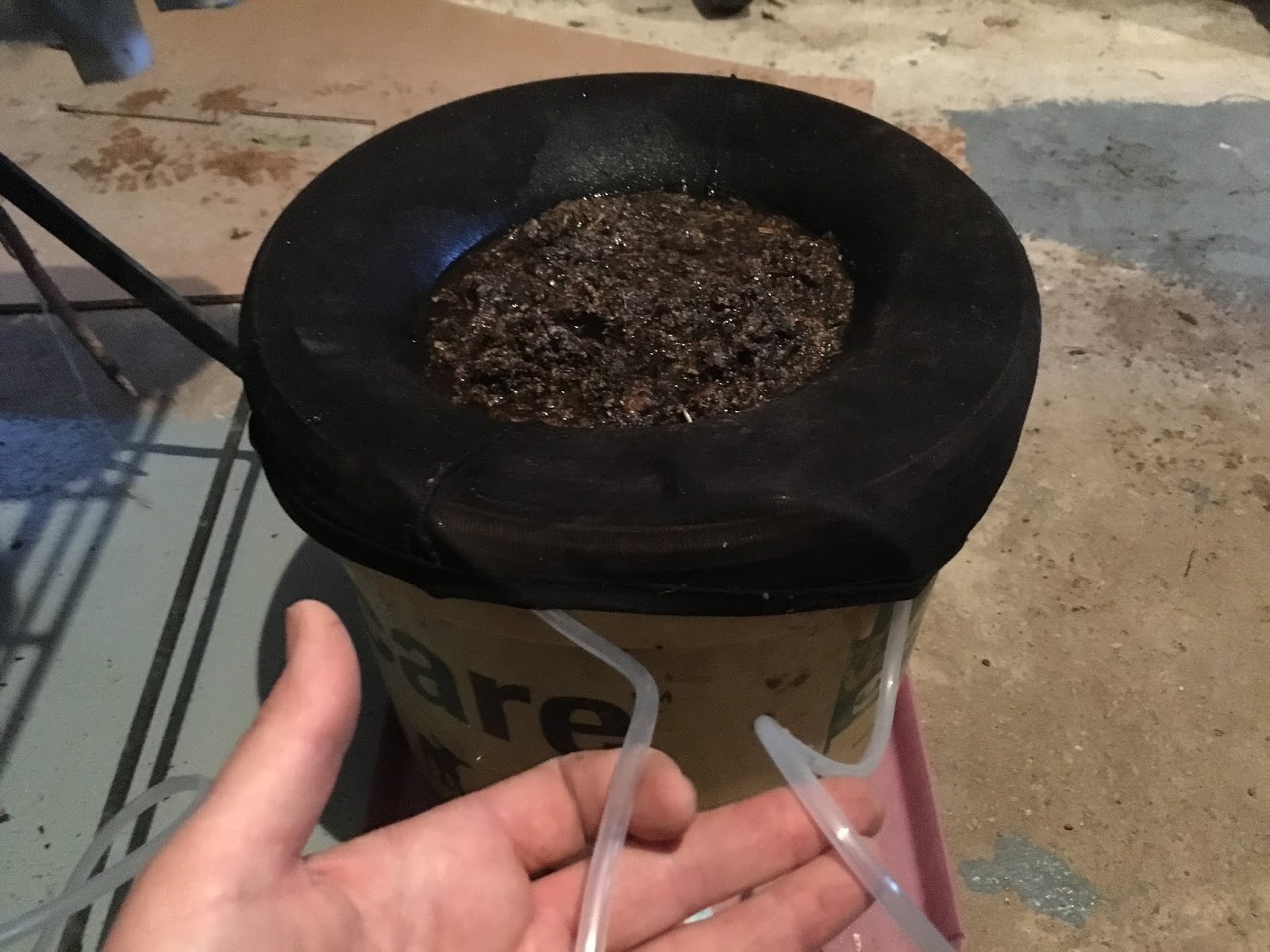
3 cups of compost. If I'm going to be watering this tea onto veg beds or lawn, I use the compost fresh from the compost bin. If I'm making tea for my perennial beds, shrubberies, forest garden or any other areas with perennials and woody plants, I first activate the fungi in the compost as these are really important mature plant partners. I basically add a handful of bran and after a few days you can see lots of fungal hyphae growing all over the compost like thick spiders' webs. This is ready to use. It goes into an old pair of tights, like a giant tea bag, to make it easy to strain out at the end. I stretch them over the top of my bucket with the aerator tubes sticking out underneath like this:
Then you need to add microbe food and habitat. The key microbes you want to feed are the smallest ones - the bacteria and fungi. These form the base of the food chain for all the higher microbes. For bacteria, you add some kind of
sugar (1.5 tablespoons) - molasses, honey, apple juice, cane sugar even. I use molasses. Fungi feed on more fibrous materials. I use
apple pulp and bran (2 tablespoons). I also add
rock dust (1 cup) - this provides minerals for the bacteria and fungi to digest and make available for my plants. I also add
liquid humates (2 tsp) - these are stable organic compounds, which can't be digested any further by microbes, but which are incredibly complex in structure and so provide habitat for these tiny creatures. They are also really good at cleaning up the soil and water by locking any toxins away.
So this mix bubbles away for a day and a half and then I dilute it down - roughly
1 litre of compost tea to a 40 litre trug of rainwater - and I water this all over my land - beds, paths and all. My 15 litre bucket of aerated compost tea was enough for our three quarters of an acre.
For a microbially poor soil like mine, or - I would say - any heavily waterlogged clay soils - your soil will really thank you if you apply this once a fortnight for three months. I'll be doing this throughout the spring. Then ease it back to monthly for the next three months.
After that and for any gardens that aren't in too bad a state to start with - you can boost your garden health further by applying this mix three times a year -
1. in spring just before your plants wake up - as a soil drench
2. in spring just after leaves unfurl - as a foliar treatment
3. in autumn after leaf fall - as a soil drench.
So having got this process started, now I wait, hoping to see some of those amazing benefits regenerative farmers are describing! I'm keeping my fingers crossed and will keep you updated.
Compost Tea Recipe
Makes 3 gallons - treats 3/4 acre
3 gallons rainwater
3 cups compost (home made)*
1.5 tbsp molasses (or other sugar)
2 tsp liquid humates
1 cup rock dust
2 tbsp fibrous material - e.g. apple pulp, bran, oatmeal
*for perennial and woody plants, activate compost by adding a handful of bran/oatmeal approx 5 days before brewing the tea. Wait until white fungal strands can be seen before using. Veg beds and lawn need no pre prep of compost.
Brew tea using submerged aerators for 1.5 days.
Dilute to use - roughly 1 litre tea per 40 litre trug (or 1 cup per 10 litre watering can).